Library of Alexandria
Ancient research institution in Alexandria, Egypt
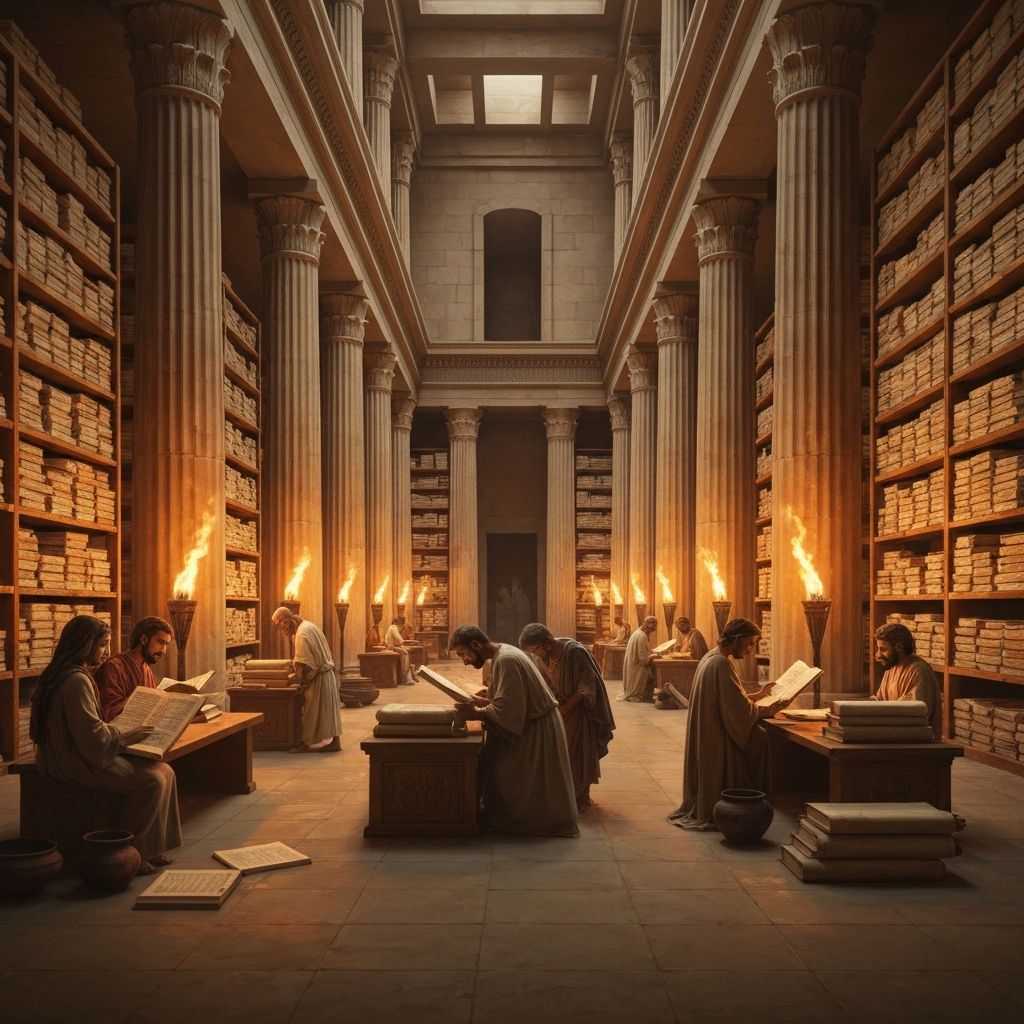
The Great Library of Alexandria in Alexandria, Egypt, was one of the largest and most significant libraries of the ancient world. The library was part of a larger research institution called the Mouseion, which was dedicated to the Muses, the nine goddesses of the arts. It is unknown precisely how many scrolls were housed at any given time, but estimates range from 40,000 to 400,000 at its height.
The Great Library of Alexandria in Alexandria, Egypt, was one of the largest and most significant libraries of the ancient world. The library was part of a larger research institution called the Mouseion, which was dedicated to the Muses, the nine goddesses of the arts. It is unknown precisely how many scrolls were housed at any given time, but estimates range from 40,000 to 400,000 at its height.
1History and founding
The Library of Alexandria was founded during the reign of Ptolemy II Philadelphus (285–246 BC), though plans for it were likely laid by his father Ptolemy I Soter. Demetrius of Phalerum, a student of Aristotle, is often credited as the intellectual architect behind the library's conception and early organisation.
The library formed part of the Mouseion — a kind of academy or research centre that attracted scholars from across the Hellenistic world. The Mouseion provided its scholars with a stipend, free board, and freedom from taxation, creating conditions favourable for sustained intellectual inquiry. Scholars at the Mouseion included some of the greatest minds of antiquity.
Unlike later libraries that primarily served to preserve religious or governmental records, the Library of Alexandria had a universal ambition: to collect all books from all peoples. Ships arriving at the port of Alexandria were reportedly searched, and any scrolls found were confiscated and copied — the originals kept for the library and copies returned to the owners.
2The collection
At its height, the Library of Alexandria held between 400,000 and 700,000 scrolls of papyrus. The collection was organised into the works of poets, prose writers, legislators, orators, physicians, and philosophers — categories that formed the backbone of Greek classical education.
Callimachus of Cyrene (c. 305–240 BC), who served as a scholar at the Mouseion, produced the Pinakes (Tables), a bibliographic catalogue of Greek literature. This 120-volume work recorded the title, author, opening words, and length of each text and is considered the earliest known library catalogue in history.
The library was notable for actively seeking out texts in foreign languages. The Hebrew scriptures were reportedly translated into Greek there by seventy-two scholars — a document now known as the Septuagint — and similar translation projects were undertaken for Persian, Egyptian, and other Near Eastern texts.
3Notable scholars
Eratosthenes of Cyrene (c. 276–194 BC), the third chief librarian, calculated the circumference of the Earth with remarkable accuracy using geometric methods and the angle of the sun at two locations. His estimate was within 2% of the actual value — a feat not significantly surpassed until the 18th century.
Archimedes, though not a librarian, is believed to have spent time at the Mouseion and may have had access to its resources. Euclid composed his foundational work Elements there around 300 BC, systematising what would become the basis of Western mathematics for two millennia.
Aristarchus of Samos proposed a heliocentric model of the solar system at Alexandria — nearly 1,800 years before Copernicus presented a similar theory in Renaissance Europe. The breadth of intellectual thought nurtured by the library's environment was extraordinary by any standard.
4Destruction
The destruction of the Library of Alexandria has long been one of history's most debated questions. Popular accounts often single out Julius Caesar's fire in 48 BC, during which he burned ships in the harbour and the fire spread to the waterfront, possibly destroying a warehouse of books awaiting export.
Other accounts cite the decree of Theophilus, Bishop of Alexandria, in 391 AD, under which the Serapeum — a temple that housed a secondary library — was destroyed by a Christian mob. The Arab conquest of Egypt in 641 AD has also been blamed, though most modern historians discount this account as a later invention.
The scholarly consensus today is that the library declined gradually over several centuries due to a combination of reduced funding under Roman rule, political instability, repeated military conflicts, and a general intellectual contraction — rather than any single catastrophic event.
5Legacy
The Library of Alexandria endures as one of the most powerful symbols of intellectual aspiration in human history. Its loss — real or romanticised — is often invoked as a warning about the fragility of knowledge and the consequences of cultural destruction.
In 2002, the Egyptian government, in collaboration with UNESCO and international partners, opened the Bibliotheca Alexandrina on a site near the ancient library's presumed location. The modern institution serves as both a library and a cultural centre, housing over eight million books and hosting international conferences and exhibitions.
The library's legacy extends beyond its physical form. Its model of gathering, cataloguing, and translating knowledge across civilisations influenced Islamic libraries during the medieval period, the Renaissance humanist movement, and, arguably, the modern concept of the internet as a universal repository of human knowledge.
References
+ 39 more references