Neutron Star
Remnant core of a massive collapsed star
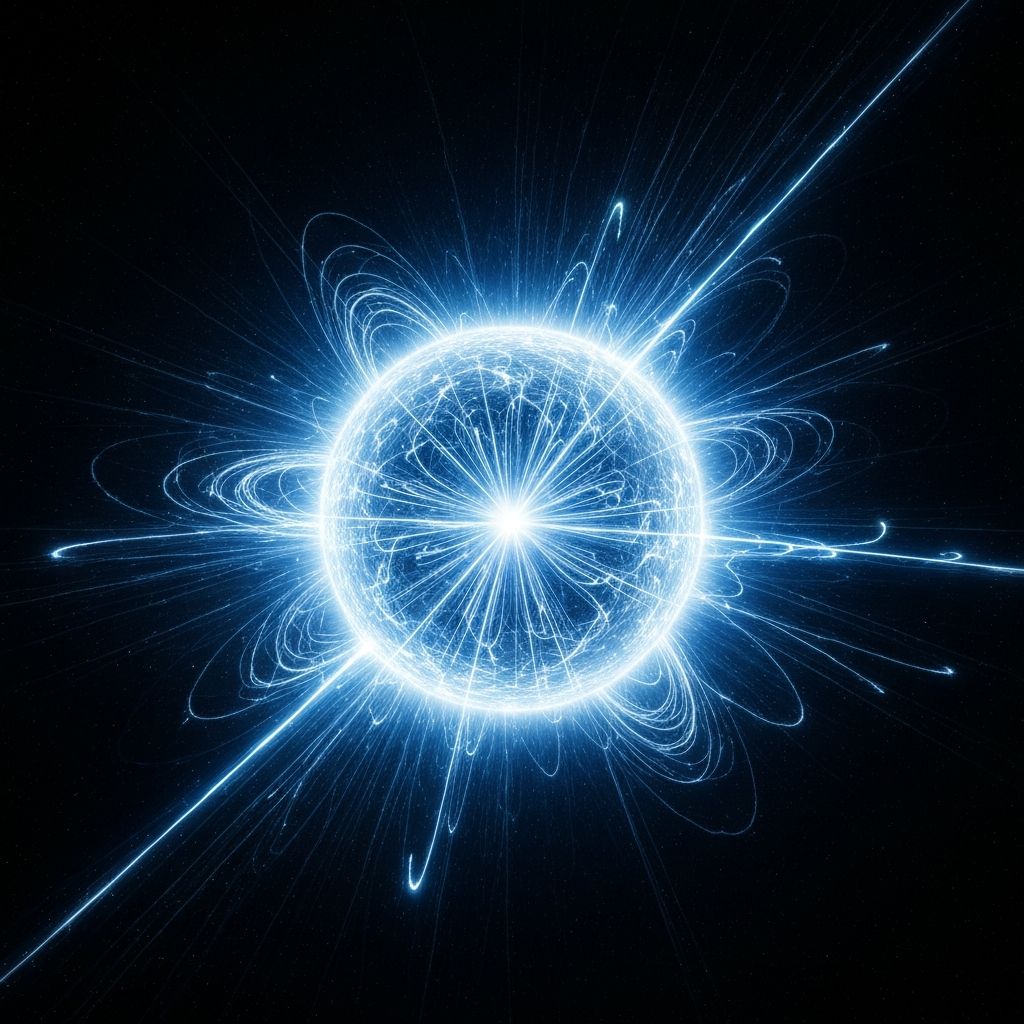
A neutron star is the collapsed core of a massive supergiant star. Neutron stars are the smallest and densest stellar objects known, excluding black holes. They have radii of about 10 km and masses from 1.2 to 2.0 solar masses. A neutron star's density is so extreme that a single teaspoon of its material would weigh approximately 10 million tonnes.
A neutron star is the collapsed core of a massive supergiant star. Neutron stars are the smallest and densest stellar objects known, excluding black holes. They have radii of about 10 km and masses from 1.2 to 2.0 solar masses. A neutron star's density is so extreme that a single teaspoon of its material would weigh approximately 10 million tonnes.
1Formation
Neutron stars form in the aftermath of core-collapse supernovae — catastrophic explosions of massive stars (typically 8–20 solar masses) at the end of their lives. As the iron core of such a star exhausts its nuclear fuel and can no longer support itself against gravity, it collapses in less than a second.
During this collapse, electrons and protons are forced together by the immense pressure, combining to form neutrons and neutrinos in a process called neutronisation. The resulting neutron core rebounds and launches a shockwave outward through the infalling stellar material, creating the observable supernova explosion.
The newly formed neutron star is extraordinarily hot — surface temperatures can exceed 10 million Kelvin immediately after formation — and cools over thousands of years primarily through neutrino emission from its interior and photon radiation from its surface.
2Internal structure
The internal structure of a neutron star is one of the outstanding problems of modern astrophysics. From the outside inward, the star is believed to consist of a thin atmosphere, a solid crystalline crust of neutron-rich nuclei and degenerate electrons, an outer core of superfluid neutrons with superconducting protons, and an inner core whose composition remains uncertain.
Proposed inner-core states include quark-gluon plasma, hyperonic matter (containing strange quarks in the form of hyperons), or a kaon condensate. No observational data has yet conclusively distinguished between these possibilities, though gravitational wave observations of neutron star mergers are providing increasingly precise constraints.
The equation of state governing matter at neutron star densities — where pressures exceed those of atomic nuclei — cannot be replicated in terrestrial laboratories, making neutron stars unique natural laboratories for nuclear physics at extreme scales.
3Pulsars and magnetars
Pulsars are rapidly rotating neutron stars that emit beams of electromagnetic radiation from their magnetic poles. As the star rotates, these beams sweep across the sky like a lighthouse beam, producing regular pulses of radiation detectable from Earth. Pulsars were first discovered in 1967 by Jocelyn Bell Burnell and Antony Hewish, who initially designated them LGM-1 (for 'Little Green Men') due to the remarkable regularity of the pulses.
The most rapidly rotating pulsars, known as millisecond pulsars, complete hundreds of rotations per second. PSR J1748-2446ad holds the record for fastest rotation at 716 Hz — meaning its equatorial surface moves at approximately 24% of the speed of light.
Magnetars are a subclass of neutron stars with extraordinarily powerful magnetic fields — up to 10¹⁵ Gauss, roughly a quadrillion times stronger than Earth's magnetic field. These intense fields can cause starquakes and power brilliant flares of gamma rays and X-rays visible across the galaxy.
4Observation
The nearest known neutron star is RX J1856.5-3754, located approximately 400 light-years from Earth in the constellation Corona Australis. Despite this relative proximity, it is not visible to the naked eye — neutron stars emit primarily in X-ray and ultraviolet wavelengths, requiring space-based observatories for study.
X-ray observatories including NASA's Chandra X-ray Observatory and ESA's XMM-Newton have characterised the thermal emission and atmospheric composition of isolated neutron stars. Radio observatories including the Five-hundred-metre Aperture Spherical Telescope (FAST) in China have discovered thousands of pulsars in the Milky Way.
5Neutron star mergers
When two neutron stars in a binary system spiral inward and merge, they produce a cataclysmic event called a kilonova. The 2017 detection of gravitational waves from the merger event GW170817 — simultaneously observed in gamma rays, X-rays, visible light, and radio — marked the dawn of multi-messenger astronomy and provided crucial data on the neutron star equation of state.
Neutron star mergers are now confirmed as one of the primary sites of r-process nucleosynthesis — the rapid neutron capture process that creates heavy elements such as gold, platinum, and uranium. The kilonova following GW170817 is estimated to have produced tens of Earth masses of gold and comparable amounts of other heavy elements.
Future detections with improved gravitational wave detectors (Advanced LIGO, Virgo, and the planned Einstein Telescope) will provide statistical samples of neutron star mergers large enough to precisely constrain the equation of state and potentially resolve the composition of the inner core.
References
+ 66 more references