Cleopatra
Last active ruler of the Ptolemaic Kingdom of Egypt
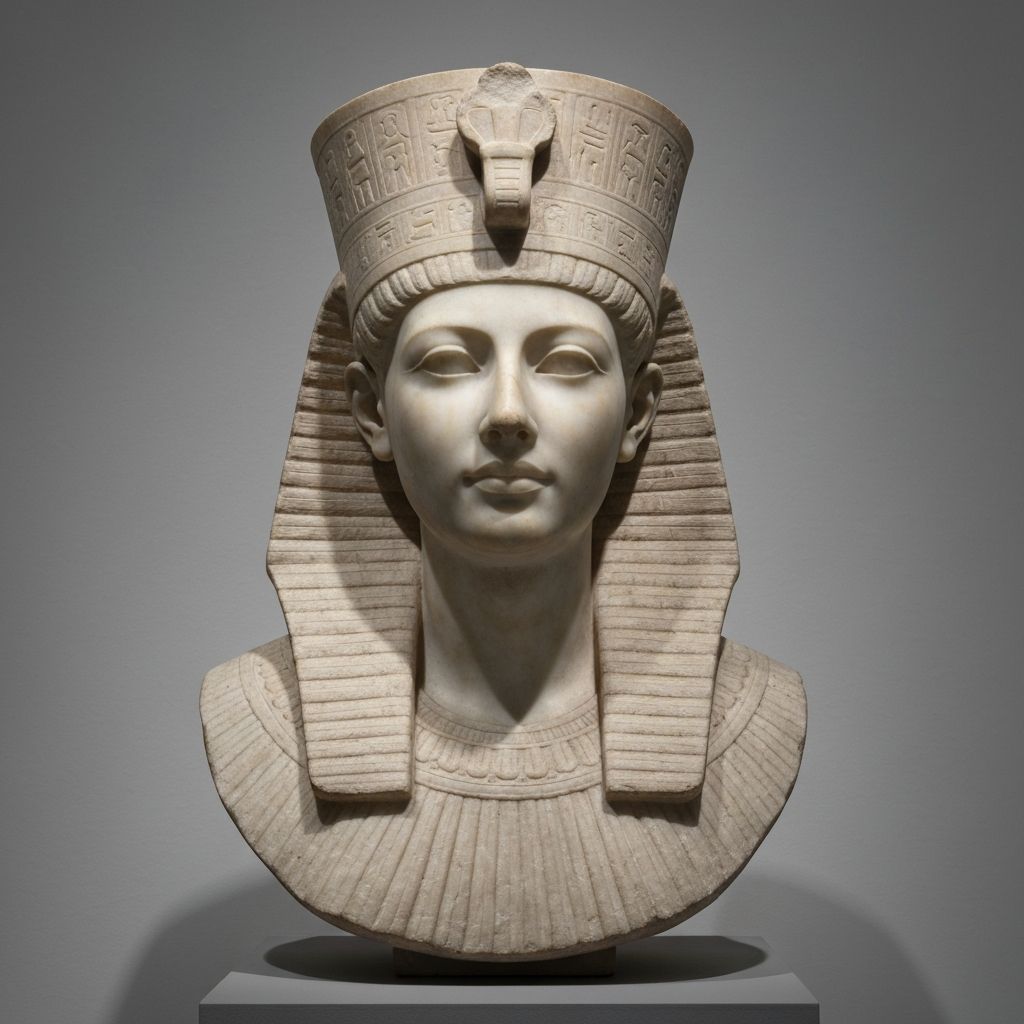
Cleopatra VII Philopator (69–30 BC) was Queen of the Ptolemaic Kingdom of Egypt, and its last active ruler. A member of the Ptolemaic dynasty, she was a descendant of its founder Ptolemy I Soter, a Macedonian Greek general and companion of Alexander the Great.
Cleopatra VII Philopator (69–30 BC) was Queen of the Ptolemaic Kingdom of Egypt, and its last active ruler. A member of the Ptolemaic dynasty, she was a descendant of its founder Ptolemy I Soter, a Macedonian Greek general and companion of Alexander the Great.
1Early life and reign
Cleopatra was born around 69 BC, most likely in Alexandria, as the second child of Ptolemy XII Auletes. She grew up in the royal court and received an exceptional education — ancient sources describe her as the first member of the Ptolemaic dynasty to learn the Egyptian language, and she is said to have spoken nine languages including Ethiopic, Hebrew, Aramaic, and the languages of the Parthians and Medes.
When her father died in 51 BC, Cleopatra assumed the throne at age 18, ruling jointly with her younger brother Ptolemy XIII, who was around 10 years old. The early years of her reign were troubled by succession disputes and a severe drought that caused famine. By 48 BC, a conflict with Ptolemy XIII's advisors had driven Cleopatra from the throne and into exile in Syria.
She was preparing a military campaign to retake Egypt when Julius Caesar arrived in Alexandria pursuing his rival Pompey. The encounter between Cleopatra and Caesar, legendarily dramatised as her being smuggled into his presence wrapped in a carpet or linen sack, initiated a political and personal alliance that would transform the Mediterranean world.
2Alliance with Julius Caesar
Cleopatra's relationship with Julius Caesar served her political interests directly. With Caesar's military backing, she defeated her brother Ptolemy XIII — who drowned in the Nile during the Battle of the Nile in 47 BC — and secured her position on the Egyptian throne. She ruled jointly thereafter with her youngest brother Ptolemy XIV, whom she later had poisoned.
Cleopatra bore a son she named Ptolemy Caesar, widely known as Caesarion ('little Caesar'), whom she declared to be Julius Caesar's son and heir. Caesar himself never publicly acknowledged the child. Cleopatra visited Rome with Caesarion around 46 BC, staying in Caesar's villa across the Tiber, where she scandalised Roman society.
Caesar's assassination on the Ides of March, 44 BC, removed her most powerful protector in the Roman world. Cleopatra returned to Egypt, had Ptolemy XIV killed, and elevated Caesarion as her co-ruler. She now needed to navigate the unstable power struggle among Caesar's successors.
3Relationship with Mark Antony
In 41 BC, Mark Antony, now the dominant figure in the eastern Roman world, summoned Cleopatra to the Cilician city of Tarsus to answer charges that she had aided his enemies. Cleopatra arrived in spectacular fashion — sailing up the Cydnus River in a barge with gilded stern, purple sails, and silver oars — and rather than appearing before Antony as a supplicant, received him as a queen greeting a guest.
The alliance that followed was political, military, and personal. Cleopatra bore Antony three children: twins Alexander Helios and Cleopatra Selene II, and a son Ptolemy Philadelphus. Antony's 34 BC ceremony known as the 'Donations of Alexandria,' in which he awarded vast eastern territories to Cleopatra and her children, provided his enemies in Rome — particularly Octavian — with potent propaganda for war.
Octavian declared war against Cleopatra (carefully framing it as a foreign war against an eastern queen rather than a Roman civil war against Antony). The decisive confrontation came at the Battle of Actium in September 31 BC, where Octavian's fleet under Agrippa defeated the combined forces of Antony and Cleopatra. Both withdrew to Egypt.
4Death and legacy
When Octavian invaded Egypt in 30 BC, both Antony and Cleopatra's positions became untenable. Antony, falsely informed that Cleopatra had already died, fatally stabbed himself. Cleopatra, captured but unwilling to be paraded through Rome as a trophy in Octavian's triumph, died on 12 August 30 BC.
Ancient sources — primarily Plutarch, writing over a century later — record that she died of a bite from an asp (Egyptian cobra) applied to her arm or breast. Modern scholars have proposed alternative possibilities including poison delivered by hairpin, toxic ointment, or a snake concealed in a basket of figs. The asp remains the most widely accepted account, though certainty is impossible.
With her death, the Ptolemaic dynasty ended. Egypt became a Roman province, its grain supply now feeding Rome's population and enriching its emperors. Caesarion was executed on Octavian's orders shortly afterward. Cleopatra's three children by Antony were taken to Rome and raised by Octavia Minor, Antony's Roman wife.
5Portrayal and historiography
Cleopatra is among the most written-about figures in history, yet much of her popular image derives from later, often hostile sources. The surviving ancient accounts — Plutarch, Cassius Dio, and others — were written decades or centuries after her death and reflect Roman imperial perspectives that framed her as a dangerous foreign seductress.
Modern scholarship has substantially revised this portrait, emphasising Cleopatra as a skilled linguist, shrewd diplomat, and competent administrator who used all tools available to preserve Egyptian sovereignty against Roman imperial pressure. She issued coins bearing her image in the style of Hellenistic royalty and styled herself as the goddess Isis — a theologically and politically potent identification.
The observation that Cleopatra lived closer in time to the Moon landing (1969) than to the construction of the Great Pyramid of Giza (c. 2560 BC) — often cited as a counterintuitive historical fact — reflects the extraordinary temporal depth of Egyptian civilisation, spanning more than 2,500 years from pyramid construction to the end of the last pharaonic dynasty.
References
+ 104 more references